
Cheylesmore Community Centre would like to hear from you if you have any images or information about its history. This includes family members who may have known it as Cheylesmore Hostel, Black Prince Avenue. It would be incredible to find pictures from the 1940s or 1950s and more. Please email paulj@cheylesmorecentre.co.uk or call 02476502226.
(N.B. – If you recognise yourselves from any of the historical pictures and have serious objections to the images being used here, just drop us a line and we will take them down.)

1899 – The present site was in or close to the “Coventry Park”, or “Cheylesmore Park” roughly where there was a farmhouse and fields known as “Coventry Old Park Farm”.
The area was a royal deer park for centuries and was often a place for horse racing. The old City Walls (which were further in from the present ring road) had a ‘Park Gate’ which was the entry into the Park!
Cheylesmore Park was owned by a series of figures including Queen Isabella in the 14th century, who later granted it to her grandson, the Black Prince, and then King Richard II. The park and Manor remained with the Crown for centuries, eventually passing to John Dudley, Earl of Warwick in the 16th century, then to the Prince of Wales, and finally the Marquis of Hertford in 1819. John Dudley leased the Park to Coventry Corporation on the condition that 80 cows and 20 geldings belonging to the poor grazed on the land.


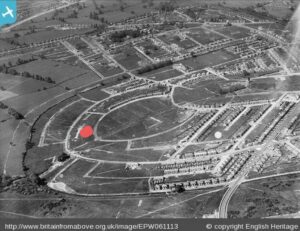
1942 – Definitely used as a school.

1942 – A document showing “plan of the Corporation’s Cheylesmore Housing”. The land shown to be available for the housing redevelopment is a block of approximately 15 acres, extending south from Poitiers Road to a border reaching the end of Foresters Road and Queen Phillipa Street (which seem to have been previously connected by a “Hainault Road”, now mostly a stretch of green space amongst the nearby housing).
1943 – Estate containing Cheylesmore Hostel controlled by Coventry Corporation, specifically the Housing Committee, which led to some competition regarding the reallocation of a lot of the space, for housing, with a previous proposal to turn it into a playing field.
1944 –The 1944 Education Act; the Ministry of Education emphasizes the need for local education authorities to establish/develop community centres (for “social, athletic [and] educational” programs), as increased industrialization and the end of the war had led to more leisure time for many.
1945 – Report submitted to the Housing Committee from Mr. D.E.E. Gibson, City Architect, regarding the proposed reuse of the Cheylesmore Hostel for housing (including the consideration of whether to retain the hostel without redevelopment (for budget purposes), or to redevelop some or all of the hostel for family based housing).
The hostel, as of the report, had the following facilities:
- Sick bay;
- Laundry facilities;
- Hairdressing block;
- Quartermaster’s stores building;
- Carpenter’s shop;
- Ambulance and fire garage;
- Boiler House;
- Managerial staff block;
- Both higher and lower grade staff blocks;
- Residents’ blocks (10 blocks holding 64 people each; included baths, showers and W.Cs);
- Welfare block (unspecified use, likely recreational facilities of some kind. This was proposed by Gibson as an ideal location for a community centre);
At this time the hostel housed 701 people in total, both staff and residents. It is reported to have had concrete floors throughout, a mix of brick and clay walls and corrugated iron and asbestos roofs. Heating was also available in all blocks.


1947 – A Mr. and Mrs. Strong play their part in the lobbying for a local entertainment venue, specifically to host their locally renowned dance classes; they succeed.
1947 – Centre provided schooling until the opening of Howes and Manor Park in the 1950’s.
1948 – Miss Davis was Caretaker logged in the visitor’s book.
1948 – 8th May: Cheylesmore Community Association formed; opened by the deputy Lord Mayor: Victor Augustus Hammond
1948 – Cheylesmore Youth Club began.
1948 – Cheylesmore Youth Centre Football Club began.
1949 – Groups on offer, as of the Cheylesmore Community Association’s first annual report, include:
- Film club (including Saturday afternoon matinees for young children);
- Dressmaking class (25 members signed, 17 in regular attendance);
- Ladies mixed crafts (around 40 members);
- Poster design/lettering;
- Mixed choir;
- Tennis;
- Table Tennis;
- Camera club (apparently poor turnout?);
- Modern dance;
- Ladies’ fitness (“Keep Fit”);
- Football (played on Whitley Common);
- Men’s crafts;
- Brief magazine published (“Cheylesmore Chat”) – abandoned after two issues at least temporarily.;
1957 – Used as a school until 1957 when Manor Park was built.
1964 – 10th June: First Citizens Advice Bureau in Coventry opens at centre.
1965 – Centre becomes a registered charity.
1965 – Pre-school opens.
Late 1960s – Still being used as a school.
1969 – 12 groups based at centre.
1971 – 19th March: Bar Lounge opened.
1972 – Volunteers re-wire centre.


1972 – The external of the building was painted.
1972 – Building converted to natural gas central heating.
1972 – 23 groups based at the centre (known as sections then):
- The Coventry Karate Club;
- The Guildhall Amateur Operatic Society and
- N.R Amateur Football Club;
- Coventry Art Guild;
- Brownies/Girl Guides;
- Dancing Classes;
- Junior Badminton;
- Styvechale CA;
- Ladies R.F.C;
- Tufty Club;
- Mothers Club;
- Cheylesmore Old Boys R.F.C;
- Falcon Fencing Club;
- Warwickshire fencing union;
- Drama;
- Over 60’s;
- Playgroup;
- Badminton;
- Ladies Badminton;
- Football;
- Neale Academy of Dancing;
- Eighteen Plus;
- Three spires Model Raceways
1974 – School Kitchen and dining area converted to a Youth facility.


1987 – Kings Church begins meeting at centre.
1988 – Asbestos Roofs replaced and Main Hall wooden floor replaced. Windows replaced around this time and some blocked up.
1991 – Centre income just 14K.
1992 – August 1st: Charity cycle ride trips to Ireland began.
1993 – August 2nd: Charity cycle ride trips to Ireland began.
1992 – Freeman Dance begin the Centre on Saturdays
1994 – Centre toy library closes.
1995 – Community industry stop luncheon club.
1996 – Weight-watchers start meeting on Centre.
1999 – Adult Education starts here.
2001 – Survived potential closure.


2004 – April: Housing Office closes. A climbing wall is built with the housing office becoming a Library.
2005 – January: New Car Park completed.
2005 – September: Football Court re-built.
2006 – Early 2007. Partially closed with access through the Library as the long wing of the centre from the offices to Preschool rooms are guttered. This was due to the needs of an aging building and partially due to Asbestos. The Main Hall became a storage area.
2006-2011 Nexus Students Volunteer on Friday afternoons
2008 – Became a Children’s Centre.
2009 – Coventry Corp of Drums begins meeting on Wednesday & Sundays.
2009 – Centre began to be painted blue.
2010 – Children’s Centre offices built.
2010 – Centre becomes charitable company.
2010 – Trustees begin looking at the future and a new Centre.


2011 – Harry Hartley chairperson passes away.
2011 – Flyte Gymnastics (formerly Flix) begin using the Centre.
2012 – Private Art Classes begin on Saturdays.
2012 – Cheylesmore Children’s Centre closes.
2012 – Spec Savers agree to sponsor new Centre brochure.
2013 – WREN funds Main Hall £72K refurbishment retaining the original ceiling shape. Cheylesmore Community Centre: Main Hall Refurbishment – Entrust
2013 – New groups include:
• Coventry Chess Academy;
• Teach Smart;
• Yoga;
• Beauty Course;
• Woodwork;
• Parkside residents.
2013 – Coventry Building Society becomes their local charity – presentation to staff.
2013 – New drawings of our dream for the Centre are unveiled initially on the present site.
2017 – Cheylesmore Library became a Community Library with corridor built to open up the East Wing.
2017 – Bardsley Car Project launched
2019 – New Main Entrance opens and Room 2 enlarged and re-modelled
2019, 2021 – Cheylesmore Youth Club launches
2019 – Freeman Dance begin the Centre on weekday evenings
2020 – Centre Closed/ partially closed due to Covid 19 with staff on Furlough.
2020 – Cheylesmore Food Hub opened in May close to Room 2
2021 – C3 Coffee Shop/ Cafe opens on 17th May after a delay of a year due to Covid.
2022 – Cheylesmore Music School is now open
2023 – More training/ education and care organisations use the Centre for training.
2025 – Coventry Car Boot sales begun running.
2025-2026 – Work under way on the Main Kitchen since receiving a grant from Severn Trent Water.